
Imprint: The content of this blog entry is based on VR experiments in the context of the Biennale 4D project that were carried out in the scope of the authors masters degree studies at FHNW University of Applied Sciences and Arts Northwestern Switzerland under the supervision of Prof. Dr. Doris Agotai.
VR today is heavily driven by technology and the design of many applications is influenced by the technology’s strong roots and prevalence in the gaming industry. Thanks to advancements in rendering and increase in computation power, photorealism is nowadays technically possible, however a higher degree of realism is not advisable for every application. It is important to critically examine what is the most appropriate rendering aesthetics for a given application context. A more realistic representation style indirectly transmits a notion of certainty, it takes much of the users attention and last but not least in the context of the Biennale 4D project it would present a big contrast to the quality and character of the archival artefacts.
Level of detail and level of hypothesis
The Biennale 4D project deals with the archives of past art exhibitions and as a matter of course incompleteness and uncertainty are in the nature of such a case. It is impossible to reconstruct the pavilion or past exhibitions with a high level of detail without making many assumptions to cover documentation gaps. In literature about 3D reconstruction within the domain of Cultural Heritage there is often made reference to the distinction between the semantic level of detail (LoD) and the level of information (LoI). While the LoD refers to the detail degree of the graphical content of a model, the LoI refers to the density of information contained and the credibility of the data sources. In “Cultural Heritage Markup Language: How to Record and Preserve 3D Assets of Digital Reconstruction” [1], Oliver Hauck and Piotr Kuroczynski offer the simple formula “LoI – LoD = LoH” to compute the hypothesis ratio within a reconstructed object, where the difference between the two values leads to the level of hypothesis (LoH). In consideration of this, a deliberate choice of a lower level of detail for the whole building is more appropriate, because it demonstrates credibility and transparency in regards to the actual level of information and still allows a continuous visual style.
Experimental Fidelity
Robert W. Lindeman and Steffi Beckhaus introduce the term “Experimental Fidelity” in their paper “Crafting Memorable VR Experiences using Experiential Fidelity” [2] which they define as follows: “Experiential Fidelity is an attempt to create a deeper sense of presence by carefully designing the user experience. We suggest to guide the user’s frame of mind in a way that their expectations, attitude, and attention are aligned with the actual VR experience, and that the user‘s own imagination is stimulated to complete the experience.” The authors encourage VR creators to carefully curate the user experience from end to end. However this shouldn’t be done by increasing the level of detail, but rather by reducing the experience to the essential components, guiding the user’s attention towards these items and giving just the right cues to frame the expectations and let the brain fill in the gaps. For the Biennale 4D project, the focus is on the exploration of archival artefacts. The reconstruction of the pavilion is nothing but a structure to hold these artefacts and its purpose is to add context to the artefacts. For this reason we reduced this structure to the fullest extent [see figure 1].
Rendering Aesthetics
Another challenge lies in defining an appropriate aesthetics for a VR application. The visual style of the virtual environment should match with all components of the application without taking away the user’s attention from the actual content. Dealing with cultural heritage archives in the context of the Biennale 4D project, which combines the three material layers of historical content, documentation of the archival artefacts and the virtual reconstruction, this means creating a continuous visual expression which complements the distinct materiality features of each layer.
For these reasons we decided to make major adjustments to the aesthetics of the Swiss pavilion in the Biennale 4D project. Various experiments lead to the new representation style, where a higher degree of abstraction was applied to the architectural reconstruction of the building. All textures and reflections of the material of the walls have been removed and the colour scheme has been inverted reducing the chromaticity of the pavilion to the highest degree: utmost black. The structure is merely indicated by wireframes [see figure 2 and 3]. Also the environment has been reduced to the absolute minimum through a reduction of the saturation of the environment to grey tones. Through these changes the building has deliberately been visually moved into the background and the archival documents receive more attention.
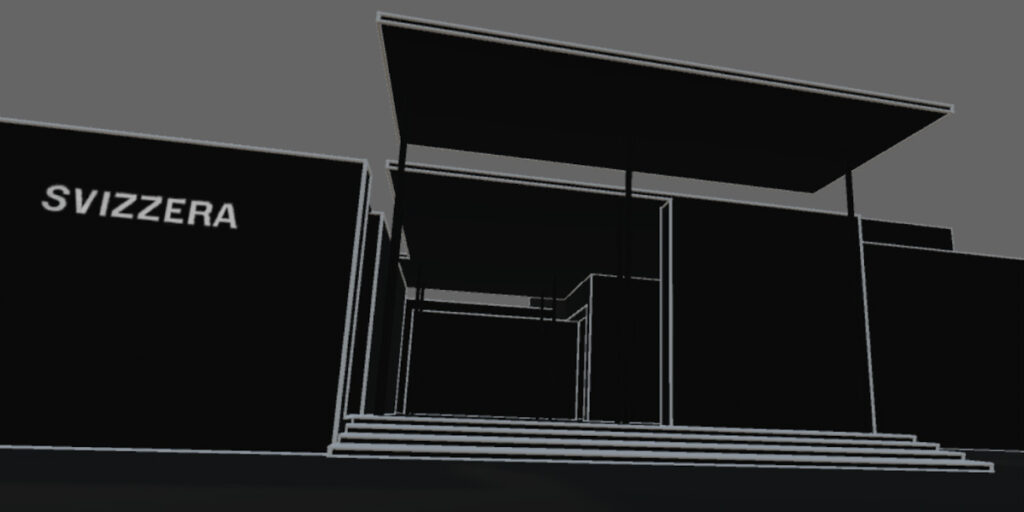
Figure 1: New rendering aesthetics applied to the model of the Swiss pavillion in the Biennale 4D VR experience, view from outside.
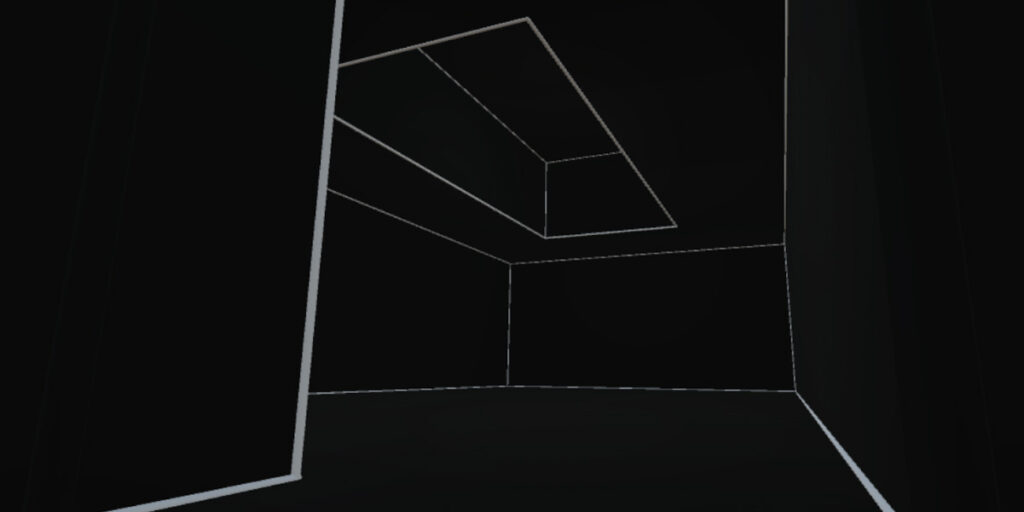
Figure 2: View into the “Malerei” hall.
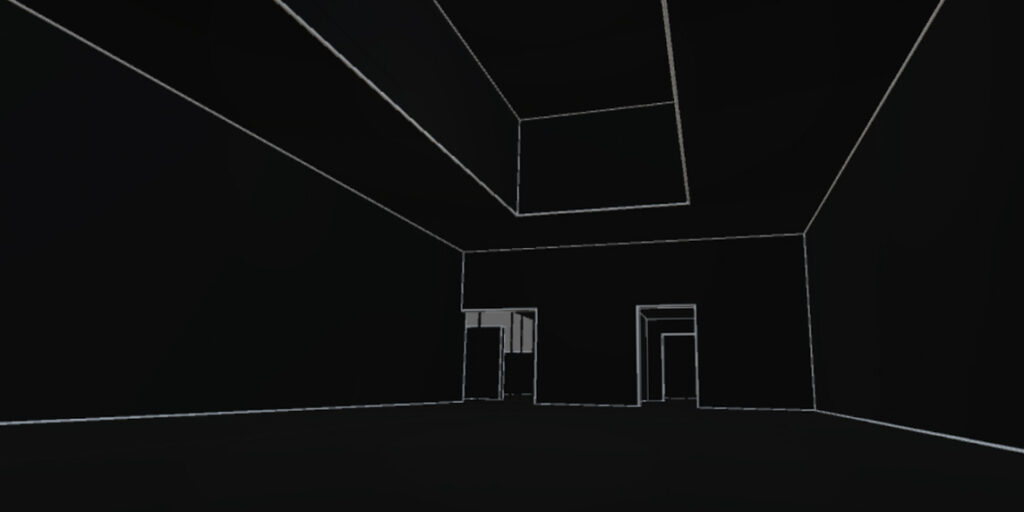
Figure 3: View from within the “Malerei” hall towards the “Passaggio”.
[1] O. Hauck, P. Kuroczynski, “Cultural Heritage Markup Language: How to Record and Preserve 3D Assets of Digital Reconstruction”, 2015 Proceedings of the 20th International Conference on Cultural Heritage and New Technologies 2015 (CHNT 20).
[2] R. W. Lindeman, S. Beckhaus, “Crafting memorable VR experiences using experiential fidelity”, Proceedings of the 16th ACM Symposium on Virtual Reality Software and Technology, pp. 187-190, 2009.