
Imprint: The content of this blog entry is based on VR experiments in the context of projects carried out in the scope of the authors masters degree studies at FHNW University of Applied Sciences and Arts Northwestern Switzerland under the supervision of Prof. Dr. Doris Agotai.
In the previous article we explained the reasoning for some of the overall design decisions of our worldmap data exploration prototype. In this article aspects of consideration for the display of individual collection items such as the form of representation, their position on the map, the display of meta information and so forth are explained.
Form of representation of the data points
Even though the collection mainly consists of physical objects, the database contains no 3D models but only photographs and metadata of the objects. On one hand side, this limits the forms of representation of the objects in virtual 3D space, yet on the other hand it poses a new challenge of finding an adequate display mode for 2D artefacts in a 3D environment. In order to create a spatial representation of the item, the photograph can be applied as a texture to a cube or a cylinder or a more common practice for this purpose is placing pictures on camera facing billboards. Concerning the camera facing mechanism, it has to be decided if all axes of the object should get aligned with the users line of sight or if the object should simple rotate around the z axis. With regard to the various perspectives the user can take from bird’s eye view to ground level view and everything in between, full adjustment of the object’s orientation is recommended.
An alternative approach would be to visualize merely the item’s meta data in the overview by the means of some abstract form of representation applying the item’s attributes to various dimensions such as size, shape, colour, transparency, etc. of a basic 3D object as it is done in many spatial data analytics tools, and only show the photograph of the item on demand. However this idea was not further pursued due to the fact that the attributes of the dataset contain mainly textual descriptions and categorical or discrete values, yet very few continuous values. Consequently there is no meaningful mapping of attributes to visual variables possible with the data at hand.
Placement of objects
There are many aspects for consideration regarding to the placement of the the collection item objects and most of them relate to the issue of uncertainty visualisation because the dataset is rather imprecise in regards to the location of origin of the individual objects. For many of them only the country or broader region of origin is known, but there is no specific geographical information available, that could be translated into precise geo coordinates. This issue has been brought up previously and we have also discussed various approaches for the visualization of uncertainty.
In regards to visualization fidelity it is not advised to anchor the items in a precise location by the means of a flag pole, a pin or another kind of marker because that level of information about the location of origin simply is not known. Let the objects float over a certain area is a better expression of the level of accuracy. In addition, a random distribution factor could be added on purpose to the position. This would also prevent the probability that multiple items are located at exactly the same location. Another way of dealing with multiple objects in proximity would be some form of clustering or stacking of objects.
Display of meta information
While the photograph of the item is considered to attract the highest interest of the target audience and therefore is displayed permanently, following the “details on demand principle” additional meta information should be available if requested. An intuitive interaction to express this request is simply pointing at an object.
Aspects of consideration for the display of meta information include which information should be displayed as well as the position where this information should be displayed, for example on top of the item itself, in close proximity, on some kind of menu floating in the virtual world or attached to the controller or in a fixed position on the user’s display. Further aspects include font size, font colour, background and text orientation. One has to balance these factors between readability, ensuring that the reference to the object is unambiguous, usability and aesthetics.
And on a side note, spoken text would for various reasons such as the general legibility of text in VR due to the limited resolution of current headsets for instance be a better option than text display, although audio presents its own challenges like leveling up with the noise level of the surrounding (taking into account that this application might be used in public spaces) or accessibility for users with hearing problems.
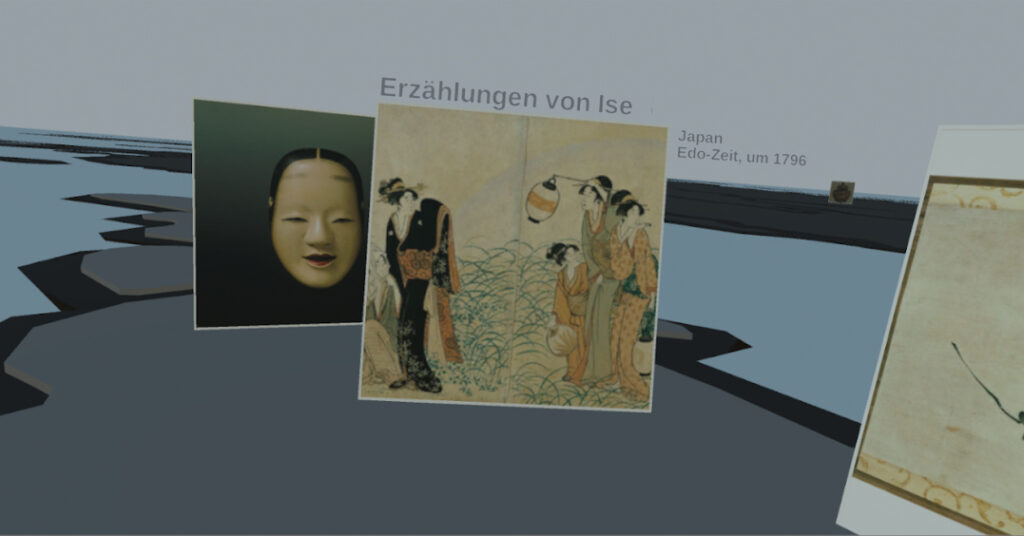
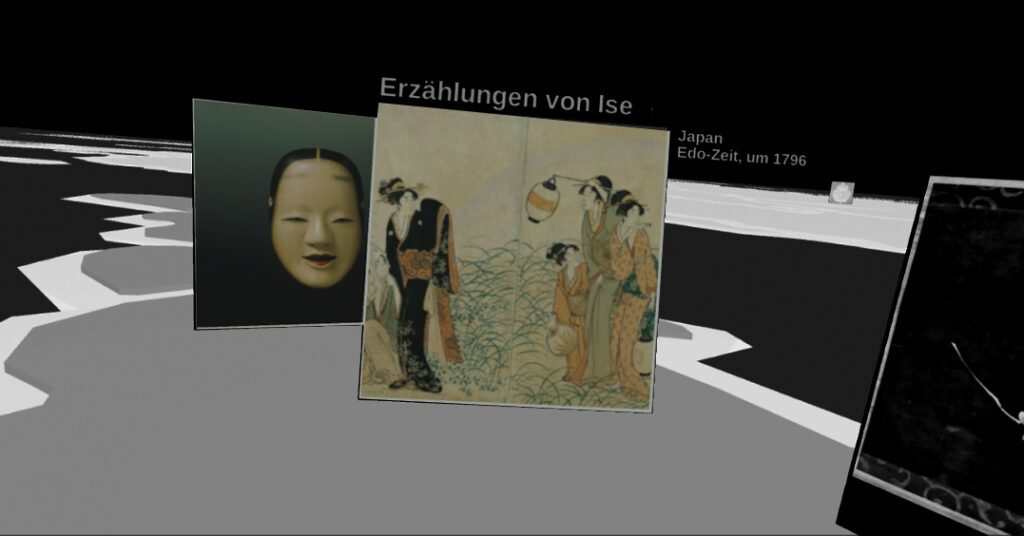
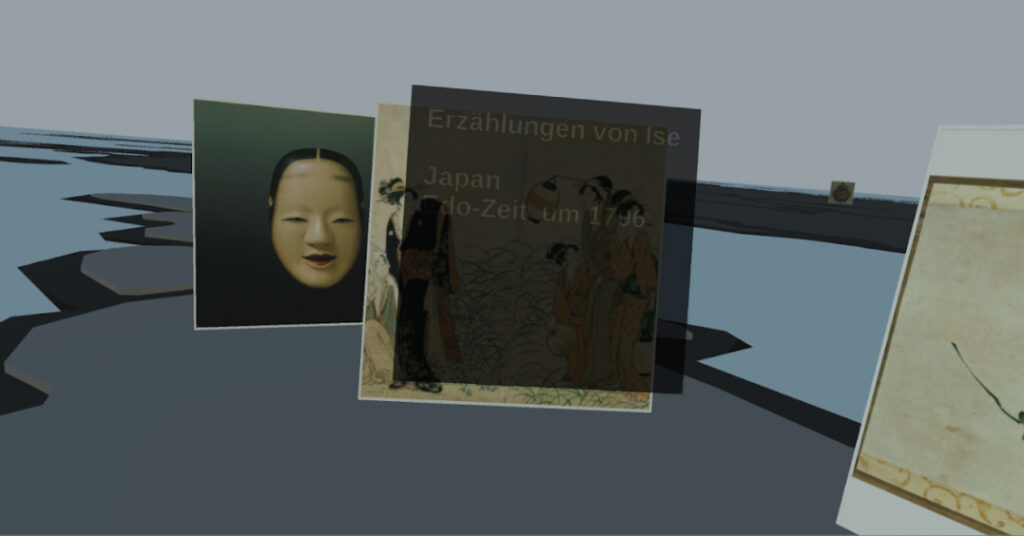
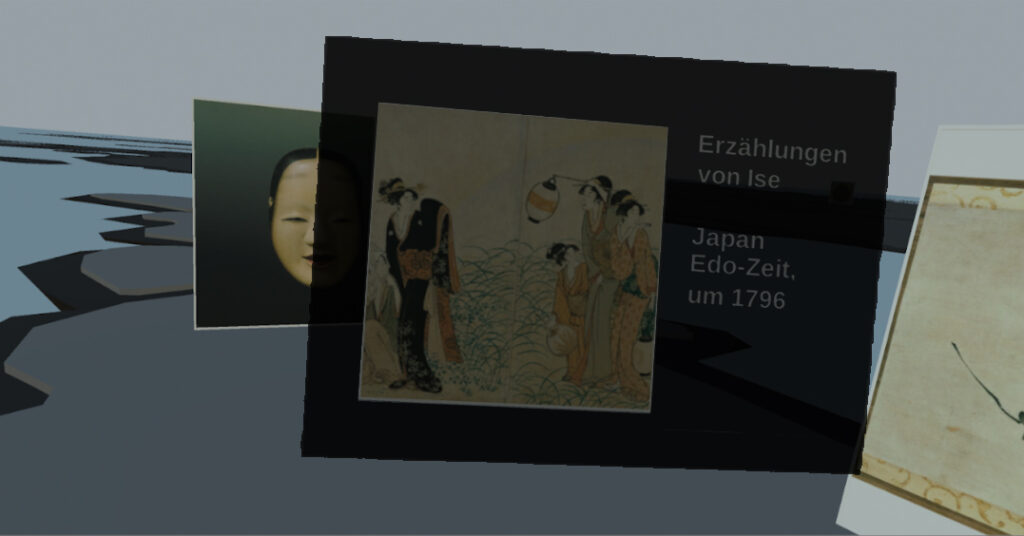
Figures 1, 3, 3 & 4: various drafts for the display of meta information
The data management of the meta information is provided through an interface, which enables automated import and export of data by the means of JSON files. Museum management database offers for each entry an object an identification number, name, short description, place and time of origin (both in textual format), material and dimension of the object as well as information about its provenance. This information is transformed into more structured data by adding additional attributes such as country code, start and end time of the time period (as numbers) to enable the filtering mechanisms offered by our prototype.
Visual and interaction design
There are a few more points to mention in regards to the visual and interaction design of the collection items. But first of all it has to be acknowledged that the mARChive project by Sarah Kenderdine and Jeffrey Shaw which allows users to explore the database of the collection of Museum Victoria in Melbourne [1], has been a great inspiration for the visual design of the collection items. Even though this project is not realized in full immersive VR, learnings are applicable because they work with similar types of content and their experience is directed towards a comparable target audience.
One remaining point for discussion is the size of the collection item objects. A question of principle is whether the object’s dimensions should be fix or if it should dynamically change depending on the distance of the viewer. It can be argued that a set size is more realistic and reinforces the discovery approach as items get larger when the user approaches it. On the contrary, if the size adapts to the user’s perspective in the same way as the width of the country outlines, it can be ensured that items are recognizable at all times and a more consistent impression is conveyed. Moreover, it has to be decided if the object should have some kind of frame or border around the photo in order to stand out against the background. Such a measure for a clearer distinction seems expedient, yet the width and style should match with the surrounding.
When it comes to the filtering interaction with the objects, an additional aspect for visualization would be to somehow visually display the degree to which an item matches the selection criterions. And last but not least, some additional general interactions with the object could include to mark items as favorites, share them with others and eventually display which items are most popular among all users.
[1] Shaw, Jeffrey: “mARChive”. URL: https://www.jeffreyshawcompendium.com/portfolio/marchive, https://vimeo.com/137801550