
Imprint: The content of this blog entry is based on VR experiments in the context of projects carried out in the scope of the authors masters degree studies at FHNW University of Applied Sciences and Arts Northwestern Switzerland under the supervision of Prof. Dr. Doris Agotai.
The purpose of the intended VR application for exploration of dataspaces in the context of museological cultural heritage collection is to enable users to gain a better understanding and insight about the data at hand by offering novel ways of representation and interaction with the data by the means of Virtual Reality. Allowing the exploration of dataspaces by a non-guided discovery approach, the intended VR experience will be of informative, self-educative as well as entertaining character. This follows Viola Rühse’s recommendation that “online archives and digital collections that combine an educational and an entertaining approach seem to be more socially valuable” [1].
Users and Use Cases
One might ask the question who would make use of an online collection or even such an virtual space for exploration of data sets? Johannes Beltz, who is in charge of curation and deputy director of Museum Rietberg pointed out in an interview that the existing web based online collection serves on one hand side exhibition visitors in the preparation of their on-site visit, and on the other hand art historians for instance for provenance research or curators and professionals of other cultural institutions for example in the search of loan objects when planning an upcoming exhibition and lastly, it’s a documentation of cultural heritage in general.
Following the Lean UX approach we designed some proto personas reflecting the anticipated categories of our target audience which by and large overlap with the four key user groups curators, collection managers, educators, and non specialists that were identified by Fiona Cameron in the Themescaping Virtual Collections research project. [2] According to Lean UX, “Proto-Personas are our best guess as to who is using (or will use) our product and why. Then, as we learn from our ongoing research, we quickly find out how accurate our initial guesses are, and how we’ll need to adjust our target audience (and persona) – and thus our design.” [3]
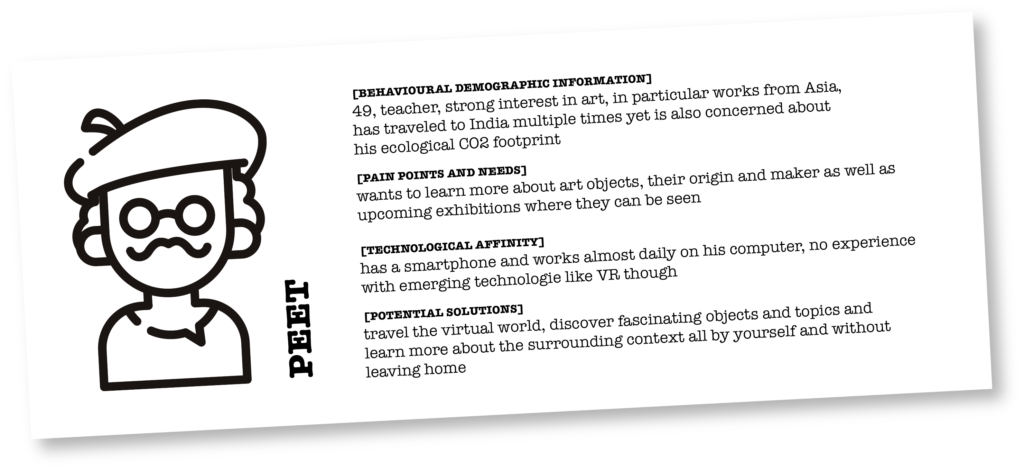
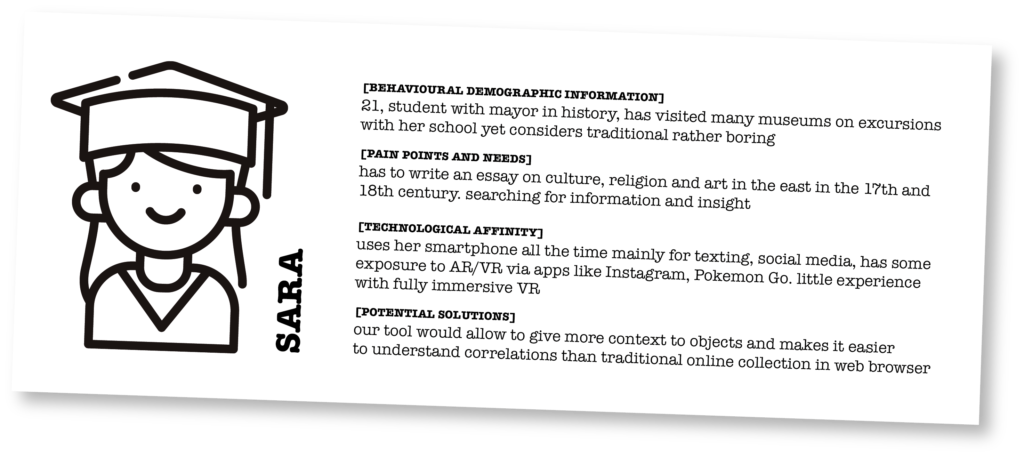
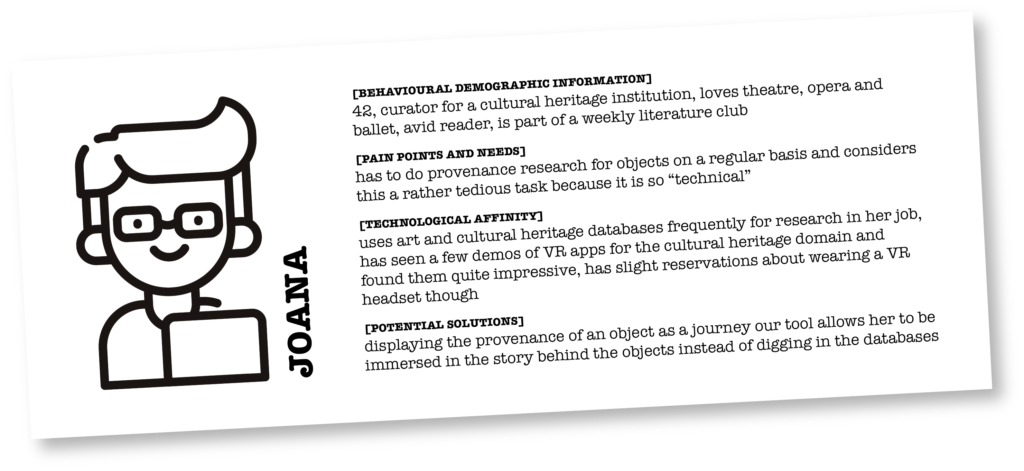
Figures 1-3: Three Proto Personas. Pictograms by Freepik and Flaticon under Creative Commons License.
Evidently more user research will be required to identify all user groups, learn more about their context and use cases and eventually understand underlying motives and needs. Also in-depth analysis of the use of the existing online collection would provide useful insights on current user behaviour and allow to see trends and tendencies in the use of the existing web platform.
However, the goal of this project is also to engage with new user groups. For this reason especially, only surveying the current user base and analyzing existing tools won’t lead to innovation. Serial entrepreneur Mark Cuban states: “Your customers can tell you the things that are broken and how they want to be made happy. Listen to them. Make them happy. But don’t rely on them to create the future road map for your product or service. That’s your job.” [4] And he further reinforces the importance of offering innovative, unconventional approaches to users: “Customers didn’t really see the value or need until they saw the new product. When they tried it, they loved it.” [5] His statement goes in line with Steve Jobs famous quote “It’s really hard to design products by focus groups. A lot of times, people don’t know what they want until you show it to them.” [6] Applying this argument to the project implies that only once the advantages of a VR tool for the exploration for dataspaces in the context of museological cultural heritage collections are demonstrated to potential user groups in form of a functional prototype, they will apprehend the benefits of this offer.
To sum up, user tests on the prototypes of our intended experience will be needed to verify the hypothesis that exploration of dataspaces in VR by the means of spatial interaction and contextualized 3D data visualisation will not only add value to the user by providing a better understanding of the data and leading to the discovery of insights but also that the exploration process will be regarded as an engaging and unique user experience that is associated with great joy of use.
[1] Rühse, Viola (2017): Chapter “The Digital Collection of the Rijksmuseum” in “Museum and Archive on the move: Changing cultural Institutions in the digital era”. De Gruyter, Berlin.
[2] Cameron, Fiona and Robinson, Helena (2007): Chapter “Digital Knowledgescapes: Cultural, Theoretical, Practical and Usage Issues Facing Museum Collection Databases in a Digital Epoch” in “Theorizing Digital Cultural Heritage. A critical Discourse” edited by Cameron, Fiona and Kenderdine, Sarah. MIT Press.
[3] Gothelf, Jeff (2016): “Lean UX: Applying Lean Principles to Improve User Experience”. O’Reilly Media Inc., Sebastopol.
[4] Sturt, David and Nordstrom, Todd : “Delight Your Customers By Giving Them What They Didn’t Ask For”. URL: https://www.forbes.com/sites/davidsturt/2014/01/03/delight-your-customers-by-giving-them-what-they-didnt-ask-for/#730220593ad5
[5] Cuban, Mark: “Mark Cuban on Why You Should Never Listen to Your Customers”. URL: https://www.entrepreneur.com/article/222501
[6] Wikiquote: “Quotes about Jobs”. URL: https://en.wikiquote.org/wiki/Steve_Jobs, originally in BusinessWeek (25 May 1998)